

Cherimoya fruitCherimoya fruit from the species Annona. It is called also custard apple. This fruit was eaten by the Inca People and come from Ecuador, Bolivia, Peru, Andes and Colombia. Now it is spread all over tropical countries, this includes also our European island Madeira. It grows at high altitude and it needs cold and hot and dry weather to grow well.
This fruit is unusually shaped. It resembles a pineapple but green and out of regular shape. It needs to be ripe in order to be eaten and you need to eat it fairly quickly after that. You can just feel the softness of the fruit to know that it is time to eat it. If the outside turns brown at room temperature than you cannot eat it anymore, if it turns brown in the fridge than it is ok to eat. Usually you should eat it within 2-3 days of being ripe and you have cut it open. I put that in the fridge to keep it from losing his vitamin C too quickly as once in the air the vitamin C will get oxidized and therefore not much of it anymore. The inside of the fruit has got big black seeds, which are poisonous to eat, so do not crush and eat them. I am not sure that if you plant them, anything will come out, you can try it. Some say that they taste of bananas, or strawberry.
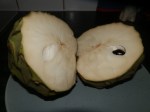
The texture of the fruit is soft and the fruit melts into your mouth. The taste is a bit funny, a bit sour and pungent, but mainly for me it tastes of nothing really, unless you put a bit of flavour in it, such as yogurt or honey.
It is a good fruit for people who have problems with sugar as it is not as sweet as many other fruits, however it can only be eaten in small pieces and in moderation each day as if you eat the entire fruit in one go, it will be still high in fructose.
Other people seems to think that it tastes like a banana, or strawberry or a soft apple.
I would use it for breakfast few pieces or in a smoothie, or with plain yogurt and a bit of honey with some blueberry. It is high in protein and vitamin C, which needs to be eaten fairly quickly after it is cut.
Nutrients content of the fruit in 100g (a medium size fruit is about 287mg without the skin and seed).
The highest minerals and vitamins are:
Potassium is about 287mg, and if you are not high in potassium than it is a good food for the heart and blood pressure.
Dietary fiber is 3 g which is pretty good, it is towards the 18g a day that you need for a good elimination success.
Unusually this fruit has got protein, which many fruits do not. It has about 1.6 g of protein, which is good to slow down the sugar level in your blood stream.
Calcium is only a small amount, but there is more magnesium, maybe that is why it is used by the Mexican for relaxation and as an antidepressant.
There is a high amount of vitamin C, and as I mentioned before, in order to keep it high, you need to store the open fruit in an air tight container or cling film in the fridge.
It has a bit of B6, which also helps with depression.
And a bit of manganese as well.
In all, this fruit is one of the superfood that you might want to eat every now and then for a variety sake.
Article written by Maria Esposito BSc (Hons) Nutritional therapist – NAET – Craniosacral Therapist
Fact information about the fruit, taken from vikipedia: Vikipedia https://en.wikipedia.org/wiki/Cherimoya accessed 20.4.17
 Craniosacral Healing /Nutrition NAET/Mindfulness living/ NlP health coach /mind body and soul